Blog · Events
ATA Creative vs Xtreme: Which Tricks and Releases Are Allowed
Can you flip in Creative? Release your weapon in Xtreme? The 2026-27 ATA rules for both events, plus the time limit, music and the traditional event each one is paired with.
Creative and Xtreme both let you write your own recipe. The difference is the pantry. Creative cooks with Songahm Taekwondo ingredients, mixed and combined in ways that are all your own. Xtreme can take ingredients from any martial art, which is why a move that's welcome in one ring isn't allowed in the next.
Creative and Xtreme are two of the eight events at every ATA sanctioned tournament, and the difference between them comes down to what you're allowed to put in the routine. Here's where the line falls under the 2026-27 ATA tournament rules.
Eight events, and six of them come in pairs
These are the eight events a competitor can enter at every sanctioned tournament:
- Traditional Forms
- Traditional Weapons
- Combat Weapons Sparring
- Traditional Point Sparring, or Traditional One-Steps
- Creative Forms
- Creative Weapons
- Xtreme Forms
- Xtreme Weapons
Nobody has to enter all eight; you and your instructor choose which ones fit.
Six of the eight are tied together, though. A Creative or Xtreme entry only counts if you also compete in its traditional partner at the same tournament: Creative Forms with Traditional Forms, Xtreme Weapons with Traditional Weapons, and so on for all four. That holds at every class of tournament.
The order the events run in, and the five minutes you get to change uniform between them, are covered in finding your ring at an ATA tournament.
Creative builds on Songahm Taekwondo
Back to the kitchen. Traditional Forms is the printed recipe, cooked the same way every time. Creative is your own dish, made from Songahm Taekwondo ingredients. Xtreme is your own dish from any shelf in the pantry.
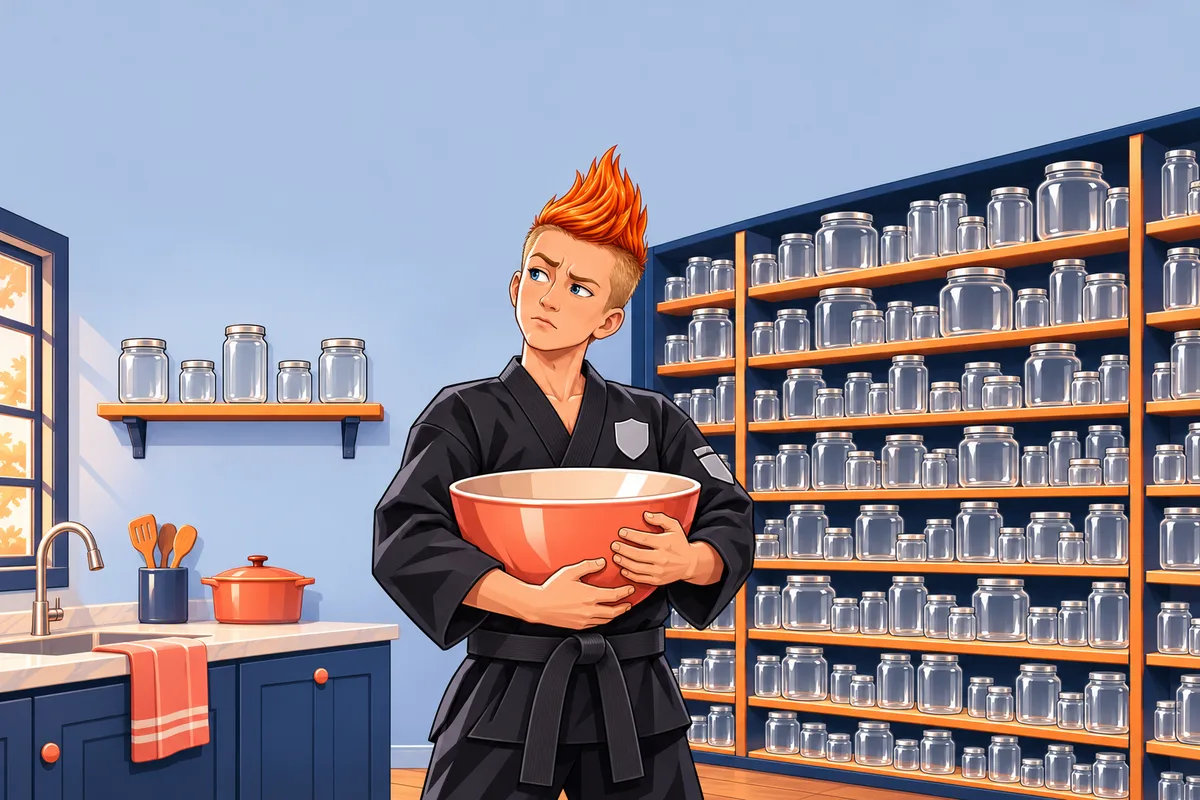
In Creative, every ingredient has to trace back to the Songahm Taekwondo forms. Mix it, combine it or build on it, but start from something in the forms.
So these are out:
- Flips. A flip is any movement with the hips above the head: a cartwheel, a back tuck, a roll, a kip-up.
- Twists. A twist is any movement where the head and hips sit parallel to the floor, which rules out Wushu butterfly kicks and butterfly kicks with twists.
- Anything past a full turn in the air. No movement with more than a 360-degree turn or twist off the ground.
- Any intended movement with the head below the waist. Leaning over to kick high is fine.
- Illusion techniques, gyro techniques, splits and the rest of the gymnastic family.
And these are in, because each one is built on a Songahm Taekwondo technique:
- A jump reverse inner crescent. An athlete who learns an inner crescent in class can build on it.
- Scissor kicks. Also triple kicks, side-twist-round, and quadruple kicks, side-twist-round-side.
- Multiple traditional butterfly kicks, and multiple spinning kicks.
Creative and Xtreme both ask for at least 50% original material, so Songahm forms can fill no more than half of a presentation. Both have a two-minute limit and no minimum. The clock starts when the judge tells you to begin and stops when you finish. A Creative or Xtreme form the whole school uses is fine, and it's judged on your performance, not on who else knows it.
If a technique is borderline, the rules say to ask the tournament department before you put it in the routine, not on the morning of the tournament.
In Xtreme, the flips are in
Xtreme is where the flash lives, but it's still based in Songahm Taekwondo. Flips, twists, more than a full turn in the air: everything Creative rules out is allowed, and there's no limit on how many tricks you add. There's no required technique list either.
The first check is safety. Your instructor has to approve every kick and combination before it goes in the routine.
Two things are still out:
- No props. Nothing comes into the ring with you except your weapon.
- No blindfold. A blindfold counts as a prop.
Difficulty isn't the whole score either. Martial arts techniques and combinations carry more value than gymnastics, acrobatics and dance, so a routine built mostly on tumbling isn't the safe bet it looks like. How a panel turns a presentation into a number is covered in how ATA forms are judged and scored.
Mind the releases
In the weapons events, the difference is clear-cut.
- Creative allows no releases. The weapon stays in contact with your hands or body for the whole routine.
- A weapon roll is fine in Creative. It never breaks contact.
- Weapon-to-weapon contact is a release. Rolling one Ssahng Nat around the other counts, because it's touching the other weapon, not you.
- A caught drop is still a release. Catching the weapon before it hits the floor doesn't change that.
- The Gum Do sheath is part of the weapon in Creative. If you carry it into the ring, it stays with you.
- Xtreme allows releases. You can also set the sheath aside, as long as you do it respectfully, and you don't have to pick it up again.
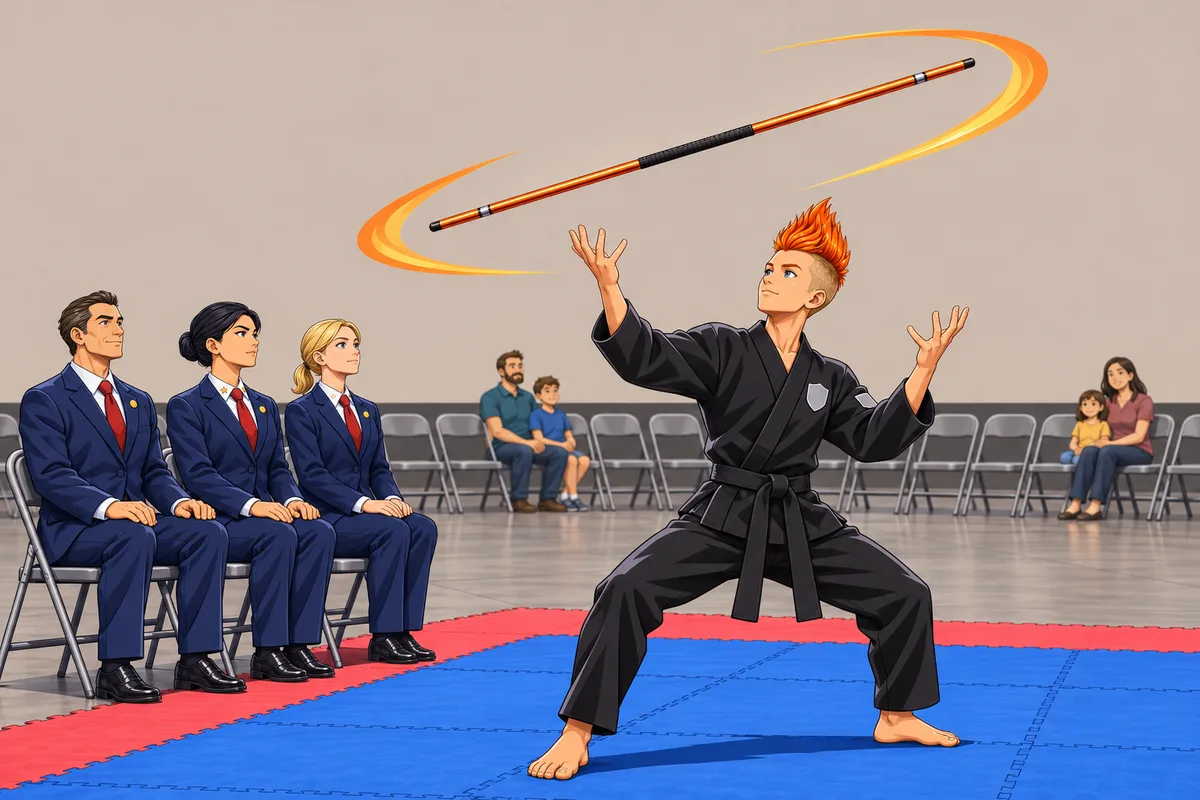
A few more rules apply in both Creative and Xtreme Weapons:
- Control is the tiebreaker. In any weapons event, a tie goes to the competitor who kept control.
- A drop costs points. One point from each judge, plus another if you pick the weapon up incorrectly.
- No single Ssahng Nat. Ssahng Nat are always used as a pair.
- A pair has to match. Ssahng Nat, double Bahng Mahng Ee, double Ssahng Jeol Bong, double Jahng Bong or double Gum Do, never one of each. Matching pairs can be different colors.
Your music does not stop the clock
Music is allowed in Creative and Xtreme, and it's never required. Your instructor approves it, and you bring your own sound system in working order.
Here's the catch. A malfunction of any kind doesn't change the time limit and doesn't earn you a restart. If the judge says your time begins now and nothing plays, start anyway, because the two minutes are already running.
Performing in time with the music can score higher, so it's worth having. It just isn't worth waiting for.
Quick answers
What happens if your weapon breaks during a routine?
There's no deduction for a broken weapon. You can borrow one from another competitor, as long as it's the same type of weapon.
Do judges check your weapon before you compete?
Yes. The judges inspect weapons before the ring starts, and you have to compete with the weapon you showed them.
Know your pantry. Then cook something nobody's seen.
ATA's own pages are the official word, and the rules can change during a season. This guide follows the 2026-27 ATA tournament rules.