Blog · Tournament day
How ATA Forms Are Judged and Scored
Three judges, scores of 1 to 9, and a 7 is better than it sounds. Here's how ATA forms are judged in 2026-27, what each judge watches, and what a zero means.
The scores go up: 7, 8, 7. From a folding chair by the ring, a parent whispers, "But that was perfect." Meanwhile the athlete is grinning, because a 7 felt pretty good.
Three black belts judge each ATA forms ring. Each one gives a score from 1 to 9, and the score compares an athlete with the rest of their ring that day. A 7 means better than the group's average. It isn't a mistake.
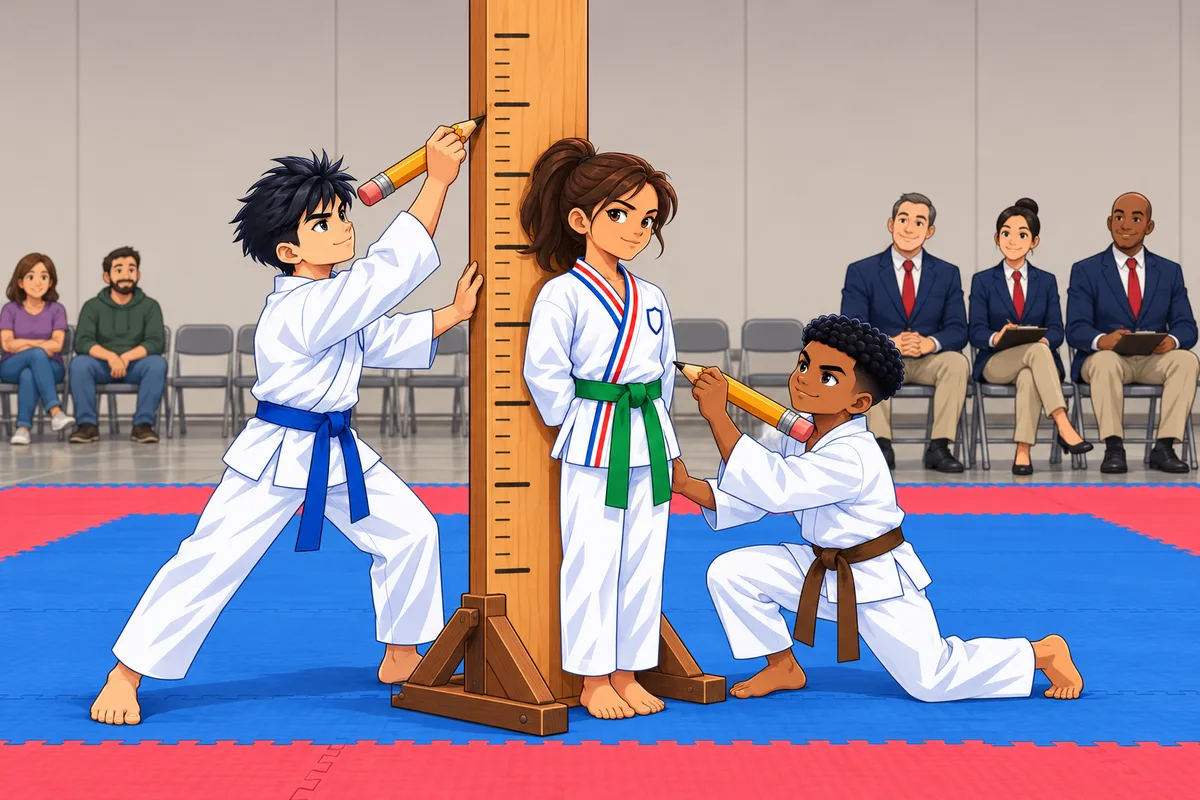
Think of it as a ruler that gets drawn fresh in every ring. The first few athletes draw it. Everyone after is measured against it.

Three judges, three jobs
Every ring except the Tiger rings has three black belt judges. Each one measures a different part of the form:
- Judge A (left of center) scores stances and kicks.
- Judge B (right of center) scores hand techniques and blocks.
- The center judge scores the overall presentation. That covers everything A and B watch, plus memory, rhythm and timing, and attitude and enthusiasm.
So that's three rulers, each measuring something different. They don't compare notes, and the rules say their scores have no relationship to each other. So an 8 from one judge and a 6 from another is normal.

The three numbers tell you which part to work on.
Judges are told to score what they see, not what their own school teaches. Small differences in how a technique looks are expected. Sparring has its own rules, so this post sticks to forms and weapons.
A score compares the ring, not a perfect form
The first three athletes in every ring perform before anyone gets a score. Those three set the ruler. Then they're called back for their scores. From the fourth athlete on, each one is scored right after their form.
| Score | What it means |
|---|---|
| 9 | Among the best in the ring |
| 6 to 8 | Better than the ring's average |
| 5 | The ring's average |
| 1 to 4 | Below the ring's average |
| 0 | Incomplete form (see below) |
That's why the same form can score a 6 one weekend and an 8 the next. The form didn't change. The ring did.
A score tells you where you landed in that ring, on that day.
You get one attempt. There's no time limit for forms, and stepping outside the ring lines isn't penalized.
A zero means the form wasn't finished
Only the center judge can give a zero, and only in a Champion ring. A form is incomplete if the athlete leaves out four or more moves in a row, or stops and doesn't continue.
Smaller slips don't count as incomplete. Skipping one or two techniques, turning the wrong way or doing a wrong technique costs points from the center judge only. Judge A and Judge B score the techniques they saw.
In Recreational rings there's no zero. Judges score what the athlete shows.
Here's how one ring adds up
Here's a made-up Champion ring of six athletes. The center judge calls the scores from the left: Judge A, the center judge, then Judge B.
| Athlete | Judge A | Center | Judge B | Total |
|---|---|---|---|---|
| 1 | 7 | 8 | 7 | 22 |
| 2 | 8 | 7 | 8 | 23 |
| 3 | 5 | 5 | 6 | 16 |
| 4 | 7 | 7 | 8 | 22 |
| 5 | 6 | 6 | 6 | 18 |
| 6 | 5 | 0 | 5 | 10 |
Athlete 2 has the top total. Athletes 1 and 4 both have 22, so they're tied. Athlete 6 stopped partway through: the center judge gave a zero, while the corner judges scored what they saw.
Ties are settled by pointing, not adding
In a ring of four or more, a tie for first, second or third means a run-off. The tied athletes each do the same form again, one at a time. An athlete who switches forms forfeits the tie-break.
This time all three judges watch the whole form. On the center judge's command, each one points to the best overall presentation. Two judges pointing at the same athlete settles it. If there's more than one tie, the lowest place is decided first.
Small rings skip the numbers. With two or three athletes, each judge points to their pick for their part of the form, and the places are recorded as 9, 8 and 7. An athlete alone in a ring gets 9, 9, 9 (the best in the ring that day), unless there's a deduction such as an incomplete form.
Weapons use the same panel, with one big rule
Traditional weapons have the same three judges, but each one scores the whole form, not one part of it. Control of the weapon comes first. A drop costs 1 point from every judge, and so does picking the weapon up the wrong way. In a tie, an athlete who dropped a weapon doesn't beat one who kept control the whole way. As in forms, a zero comes only from the center judge, for an incomplete form.
Who the judges are
Judges are black belts who pass an online test (80% to pass) for their judging level, and it's valid for one year. Level 1 judges sit at the corners, Level 2 judges can sit in the center and Level 3 are chief judges. Higher levels can sit in higher-ranked rings.
What to do with the numbers
Judges aren't supposed to give a clinic after an event. The ATA's advice is to use the scores for feet, presentation and hands, and take them to the instructor.
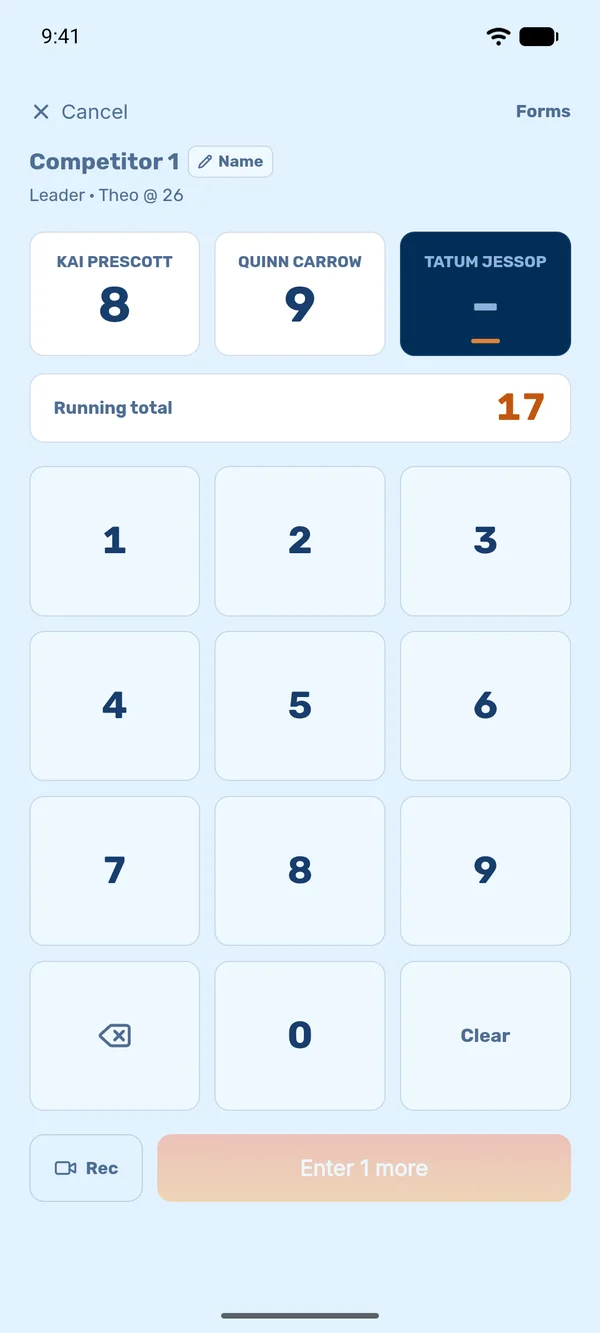
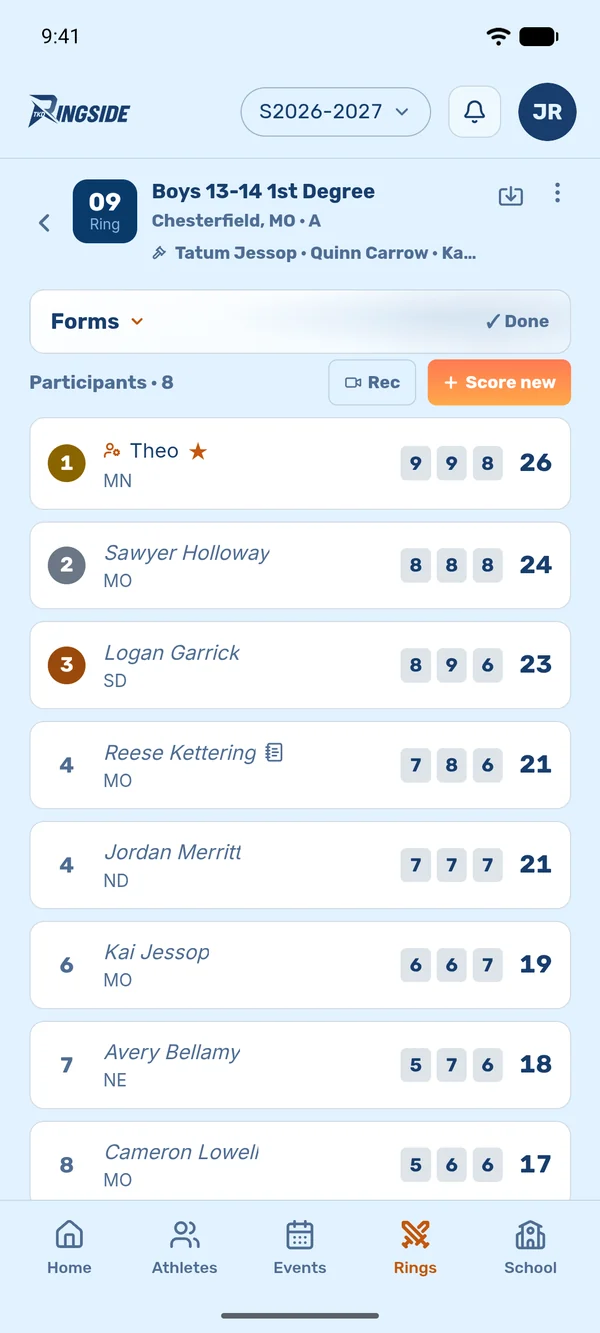
That's easier when the three numbers are written down. In TKD Companion, you enter each judge's score as it's called, and the ring shows every score, the total and the placement.
Quick answers
What's a good ATA forms score?
Anything above 5 is better than the ring's average that day. A 9 is among the best in the ring.
Who gives a zero in ATA forms?
Only the center judge, and only in a Champion ring, when a form is incomplete.
Can an athlete redo a form?
No. Each athlete gets one attempt. The exception is a tie for first, second or third, where the tied athletes repeat the same form.
How are rings with two or three athletes scored?
The judges point to their pick instead of giving numbers, and the places are recorded as 9, 8 and 7.
So the next time a 7 goes up and a parent whispers, you'll know it's above the line.
ATA's own pages are the official word, and the rules can change during a season. This guide follows the 2026-27 ATA tournament rules.