Blog · Team events
How ATA Team Sparring and Team Combat Work
Three competitors, three fights, one running score. Here's how ATA team sparring and team combat work in 2026-27, who can join, and how team points add up.
An athlete walks out of the ring after losing 5–3, and their teammates are cheering. Not because the loss doesn't matter, but because those three points do.
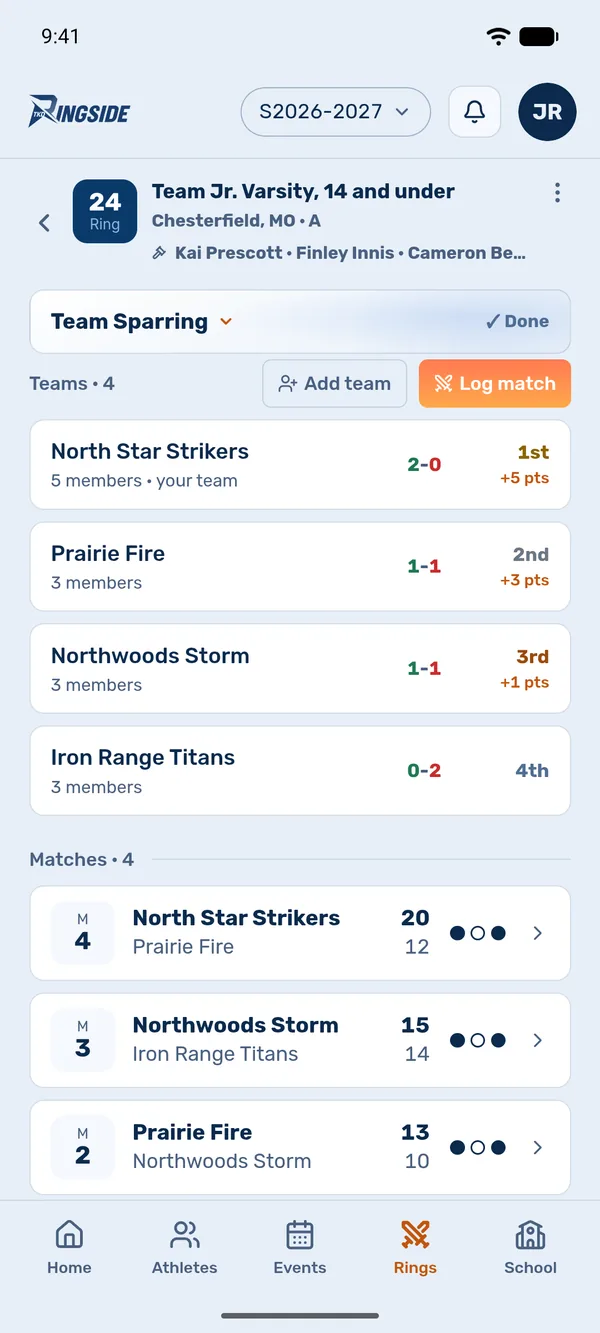
That's ATA team sparring. A team of three black belts (one female and two male competitors) takes on another team in three fights of 1:30 each. Every point from every fight goes into one running team score. All three fights are fought, and the team with more points at the end wins the match.
Team combat works the same way with combat weapons, and both events earn team points that can lead to a title.
Think of it as a jar. Every point a competitor scores drops into the team's jar, and nothing ever comes out. Losing a fight 5–3 still puts three points in the jar.

Three fights, one running score
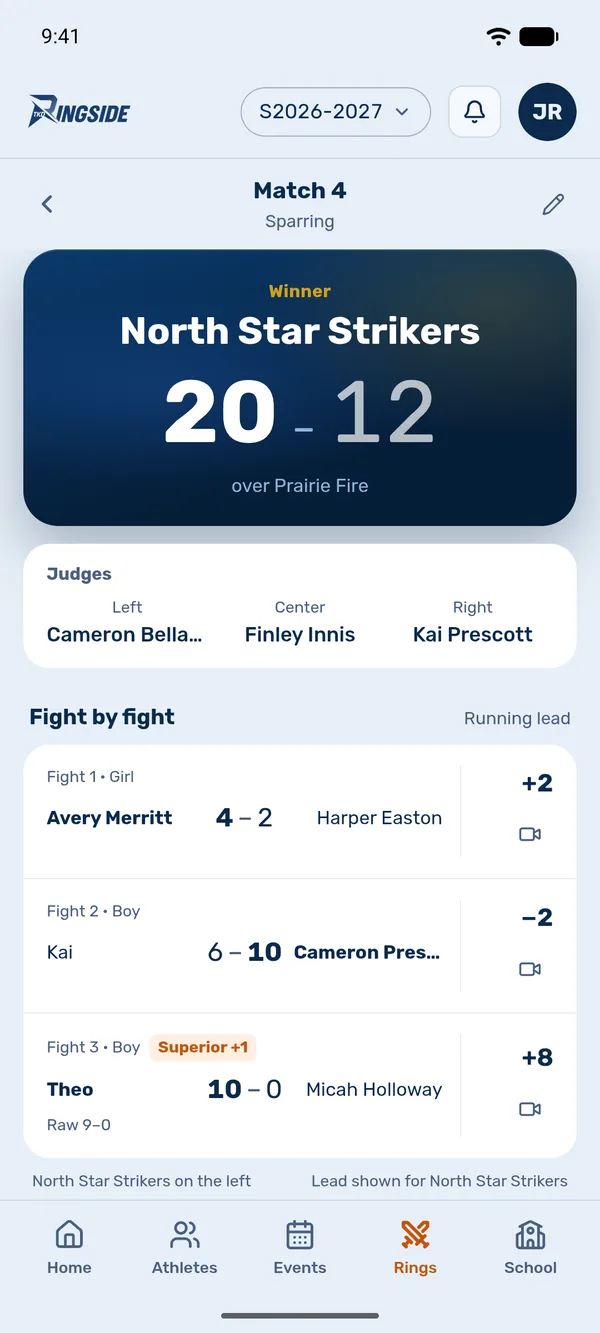
A team match is three fights. Each fight puts one competitor from each team in the ring, and it runs the full 1:30 regardless of the score. There's no point cap in a team fight, so a competitor who's far ahead keeps scoring.
- Ties go to sudden victory. That goes for a tied fight and for a tied team score after fight 3.
- A big win earns a bonus point. Win a fight by 8 or more points (11 or more in team combat), and the team gets one extra point. ATA calls it a superior decision.
- A missing competitor still costs points. A team can compete with only two members, but the other team gets 7 points (10 in team combat) for the fight that doesn't happen.

Here's how a made-up Jr. Varsity match plays out. Before it starts, each coach hands the center judge their three primary starters.
- Fight 1: Team A wins, 9 to 1. That's a gap of 8, so Team A banks the bonus point. The running score is 10 to 1. Winning the fight also gives Team A a choice: its coach chooses a girls' fight next, and Team B has to send out its competitor first.
- The coaches never go quiet. Team events are the only ATA events where coaches can coach from ringside, and they can step into the ring with a pointer whenever the judge stops the action.
- Fight 2: Team B wins, 5 to 3. The running score is 13 to 6. Team A's competitor just lost, and Team A's bench is cheering anyway.
- Fight 3: Team B wins again, 6 to 4. Only the boys' fight is left, so there's no choice to make. Team A wins the match, 17 to 12.
Team A lost two of the three fights and won the match. Every point counts, even in a fight you lose.
And the crowd gets loud. Cheering and chants are welcome, as long as they're positive. Judges can warn a team for taunting.
Team combat works the same way
Team combat is the same three-fight match, fought with combat weapons. Only the numbers change because the two events score points differently:
- Team sparring uses traditional sparring points: 1 for a hand technique or a kick to the body, 2 for a kick to the head or a jumping kick to the body, and 3 for a jumping kick to the head.
- Team combat uses combat weapons sparring points: 1 for a strike or stab to the body; 2 for a strike to the head, a strike to the weapon arm below the elbow, or a stab to the front thigh; plus 1 for a jumping technique, with no more than 3 points scored at once.
That's why the bonus point comes at 8 in sparring but 11 in combat. Combat jars fill faster.
Who can be on a team
Not everyone gets to put points in the jar. For a regional team in 2026-27, every member needs:
- A black belt. That means 1st Degree Decided or higher. A 1st Degree Recommended black belt can join only at a tournament where they compete in the Decided black belt rings.
- The matching individual event, same day. A team sparring member also competes in traditional sparring at that tournament, and a team combat member also competes in combat weapons sparring. Championship and Recreational rings both count. Skip the individual event, and the team loses its points from that tournament.
- The ATA Leadership program. Every member, alternates included.
- The same state and district. Every member trains in the same state and district as the team's school. New for 2026-27, a school's district is set by its zip code.
Competitors in Special Abilities divisions aren't eligible for team sparring or team combat, and 6th and 7th degree black belts aren't eligible for regional teams.
Teams compete by age/rank division. Junior teams take 1st to 3rd degree black belts, while adult teams take 1st to 5th degree black belts.
| Junior division | Ages | Adult division | Ages |
|---|---|---|---|
| Bantam | 8-10 | Elite | 18+ |
| Rookies | 12 and under | Premier | 30+ |
| Jr. Varsity | 14 and under | Legends | 40+ |
| Varsity | 17 and under | Executive | 50+ |
Outside Bantam, the youngest competitor is 9. Juniors can move up to an older junior division, but they can't cross into the adult divisions. Adults work the other way: they can move down to a younger adult division, but not up to an older one. Competing in both? Your athlete has to be in the same age division for team sparring and team combat.
A team starts with a coach and a Team ID
A team needs a certified coach: someone with ATA's Level 1 coaching certification from a coaches clinic. Before the season, the coach applies for a Team ID, and team name approval can take up to 30 days.
The Team ID is the label on the jar. If it isn't on the roster, the points from that tournament don't count.
- Rosters are due early. For a regional, the coach sends the roster to the region's Regional Tournament Team Leader (RTTL) by 8 a.m. on the Wednesday before.
- Up to five per tournament. A season roster can be any size, but at most five members (two female, three male) can compete at one tournament. The coach names three primary starters for each match.
- A podium locks the roster. Once a team places 1st, 2nd or 3rd, everyone on that roster is locked to that team for the rest of the season.
Team points go to the team
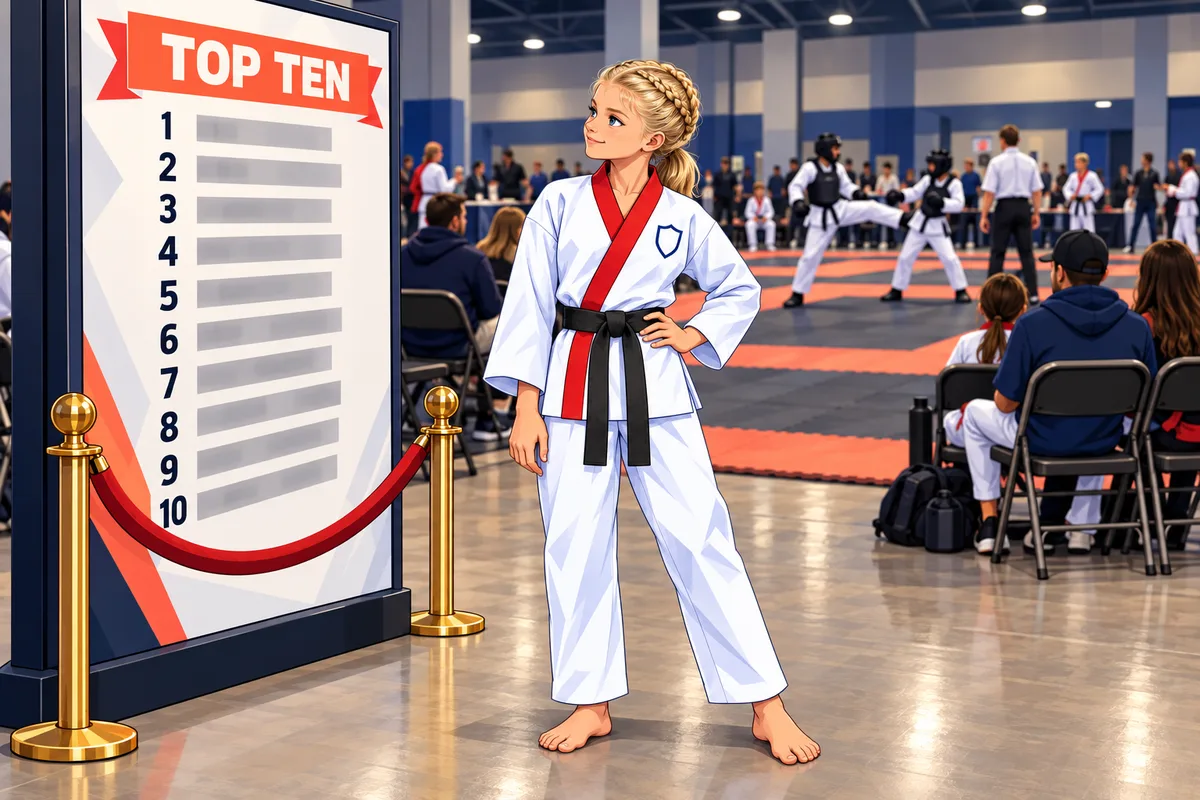
Team points belong to the team, not to its members. They build a separate State Team Top Ten and never add to an athlete's own event totals.
| Tournament | 1st | 2nd | 3rd |
|---|---|---|---|
| Regional (Class A+, A or B) | 5 | 3 | 1 |
| National (Class AA) | 10 | 8 | 5 |
- Full points regardless of turnout. In-school (Class C) tournaments award no team points.
- Only the best results count. Five regionals and two of the three Nationals (Fall, Spring and Pan Am).
- The list posts monthly. ATA posts the State Team Top Ten once a month.
Those points lead to team titles: State Champion, then District Champion, then World Champion at the Tournament of Champions. The road there works like the one in how to qualify for ATA Worlds, and the lists are covered in the Top Ten guide.
Quick answers
Can a color belt compete in ATA team sparring?
No. Team sparring and team combat are for black belts only.
Does ATA team sparring count toward the individual State Top Ten?
No. Team points build a separate State Team Top Ten.
How many people are on an ATA sparring team?
Up to five competitors can be on the roster at a tournament, but only three compete in each match: one female and two male.
So the next time a team is cheering after losing a fight, you'll know why. They're watching the jar.
ATA's standings pages are the official word, and the rules can change during a season. This guide follows the 2026-27 ATA tournament rules.